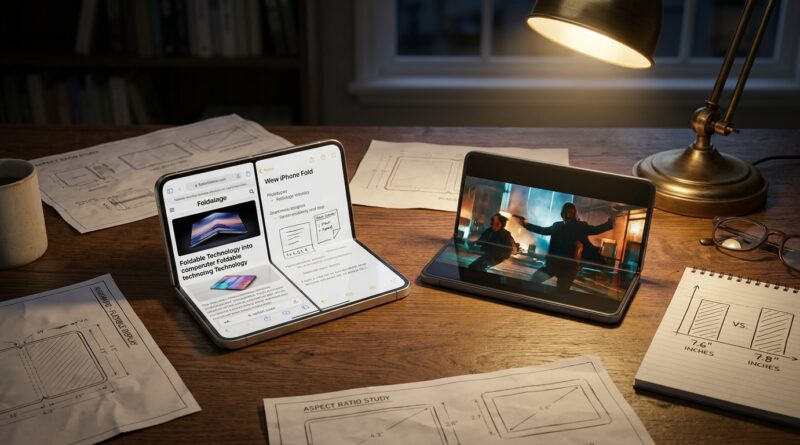
iPhone Fold ‘Aspect Ratio Hack’: The Wide‑Screen Leak That Quietly Explains Apple’s First Foldable Design
If you are stuck between buying Samsung’s Galaxy Z Fold 8 now or waiting for Apple’s first foldable, I get it. The leaks are messy, the screen numbers sound close enough to be meaningless, and every rumor account acts like half an inch here or there changes everything. But with foldables, the shape of the screen matters just as much as the size. That is the part most people are missing.
The big clue from recent iPhone Fold vs Galaxy Z Fold 8 leaks is not that Apple may copy Samsung’s general book-style design. It is that Apple seems to be aiming for a wider, more square inner display that behaves less like a stretched phone and more like a mini iPad. That sounds subtle. It is not. It affects typing, video, app layouts, split-screen use, and whether this thing feels useful or just expensive. If the leaks are right, Apple is not trying to beat Samsung on “first foldable cool factor.” It is trying to fix the old complaint that many foldables open into a screen that still feels awkward for everyday work.
⚡ In a Hurry? Key Takeaways
- Apple’s rumored foldable appears focused on a wider, squarer inside screen, which could make it feel more like a small iPad than Samsung’s more phone-first foldables.
- If you need a foldable this year, the Galaxy Z Fold 8 is the safer buy because it is real, available, and its software is mature. If you care most about iPhone and iPad app polish, waiting may make sense.
- Do not lock yourself into a long carrier deal based only on screen size specs. Aspect ratio changes how comfortable the phone actually feels in your hand and in apps.
What this “aspect ratio hack” really means
When people talk about foldables, they usually talk about inches. A 7.6-inch display. An 8-inch display. Maybe a thinner hinge. Nice. But that skips the real question. What shape is the screen?
A long, narrow foldable screen and a wider, squarer foldable screen can measure almost the same diagonally and still feel completely different. It is like comparing a studio apartment and a hallway. Same square footage, different life.
That is why the latest iPhone Fold vs Galaxy Z Fold 8 leaks matter. Apple’s rumored layout suggests it may want a wider inner panel, one that gives apps more usable width instead of just more diagonal size. In plain English, Apple may be building a foldable that opens into something closer to “small tablet” than “big phone.”
Why Apple may be doing this
Apple usually avoids shipping a new category until it has a clear answer to one annoying problem. For foldables, that problem is easy to spot. Many current models are impressive when you first open them, but after the wow moment, you notice some apps still feel cramped, split-screen can feel compromised, and the outer screen can be either too narrow or oddly shaped for one-handed use.
Apple’s possible fix is not magic. It is geometry.
A wider inside screen helps ordinary stuff
If the inner display is more square, you get more room side by side. That helps with:
Reading websites without everything looking squeezed.
Using two apps at once without both becoming tiny.
Typing on a larger on-screen keyboard that does not feel stretched.
Running iPad-style layouts in apps like Mail, Notes, Files, or Safari.
It also explains the “half-iPad” look
Some dummy unit comparisons and leaks have made Apple’s rumored foldable look a little odd. Not bad. Just different. That “why does it look like half an iPad mini?” reaction may be the whole point. Apple may be trying to make its foldable a true bridge between iPhone and iPad, not simply an iPhone that happens to bend.
How this compares with Samsung’s Galaxy Z Fold 8
Samsung has a huge head start here. By the time Apple shows up, Samsung will have spent years fixing hinge durability, multitasking tricks, app scaling, and the simple day-to-day weirdness of folding phones.
The Galaxy Z Fold 8, based on store demos and leak chatter, seems to continue Samsung’s push toward a more practical wide-screen foldable. That matters because Samsung also seems to understand that people are tired of narrow cover screens and awkward tablet ratios.
So yes, Apple may be following Samsung in some broad hardware choices. But the likely difference is software intent. Samsung builds foldables like power-user phones. Apple may build one like a pocket iPad.
Samsung’s advantage right now
It exists. You can touch it, test it, and return it if you hate it.
That sounds obvious, but it is important. Buying a foldable is not like comparing two ordinary candy-bar phones. You really need to feel the cover screen width, the weight, the crease, and the unfolded shape. Best Buy aisle comparisons may look silly online, but honestly, they are useful.
Apple’s likely advantage later
If Apple gets the aspect ratio right, the big win may be app behavior. Apple controls iPhone apps, iPad apps, and the design rules between them more tightly than most Android phone makers can. If it can persuade developers to treat the foldable like a serious iPad-style canvas, that could make the device feel less like a novelty and more like a daily tool.
The real buying question: phone first, or mini tablet first?
This is the easiest way to cut through the noise.
If you want a device that is mainly a phone but can open into a bigger screen when needed, Samsung is the proven choice. If you want a device that might feel more like carrying a mini iPad that also works as your phone, Apple’s rumored approach makes more sense.
That is the quiet story hidden inside these leaks. The debate is not just Apple versus Samsung. It is two ideas of what a foldable should be.
Should you wait for the iPhone Fold?
Maybe. But only if you match the wait to your habits.
Wait if these sound like you
You live in the Apple ecosystem and use iPad-style apps a lot.
You keep phones for three years or more.
You hate buying first and feeling buyer’s remorse six months later.
You care more about screen shape and software polish than being first.
Buy the Galaxy Z Fold 8 now if these sound like you
You want a foldable this year, not a rumor next year.
You multitask heavily and already like Samsung’s software features.
You are comfortable with Android.
You can get a strong trade-in deal that lowers the risk.
What not to do
Do not compare only the diagonal measurements.
Do not assume “Apple copying Samsung dimensions” means the two products will feel the same.
And definitely do not sign a three-year carrier contract because a salesperson says, “they are basically the same size.” They are not, if the aspect ratio changes how the screen is used.
My practical advice for normal buyers
If your current phone is fine, wait for more concrete iPhone Fold details before making a long commitment. This is one of those rare cases where patience can save you from buying the wrong category, not just the wrong model.
If your phone is dying now and you already know you like foldables, the Galaxy Z Fold 8 is the less risky move because it is a finished product with real reviews, store units, and real-world battery and durability reports.
If you are iPhone-only and know you would regret leaving iMessage, AirDrop, Apple Watch, or iPad integration, I would be careful about jumping ship just because Samsung’s hardware is available first. Ecosystem regret is real, and it gets expensive fast.
At a Glance: Comparison
| Feature/Aspect | Details | Verdict |
|---|---|---|
| Inner display shape | Galaxy Z Fold 8 appears tuned for a mature foldable phone experience. Apple’s rumored fold aims for a wider, squarer panel that may feel more like a mini iPad. | Apple could win on comfort and app width if the leaks are right. |
| Software feel | Samsung has years of multitasking and foldable software refinement. Apple may bring tighter iPhone and iPad app integration, but it is still unproven. | Samsung wins today. Apple has upside later. |
| Buying decision | Samsung is available now. Apple is still a rumor with promising design logic but no final product to test. | Need a foldable now? Buy Samsung. Can wait and love Apple? Hold off. |
Conclusion
The useful takeaway here is simple. The rumored iPhone Fold is not just trying to be Samsung’s Fold with an Apple logo. The leaks suggest Apple is focusing on the shape of the experience, not only the size of the screen. That wider, half-iPad style layout may be its way of fixing the biggest foldable complaint: opening the phone and still feeling like you are working around the screen instead of enjoying it. This helps the community right now because the foldable debate is no longer niche. The next big phone decision is not just Pro or Pro Max. It is slab or fold. And with the Galaxy Z Fold 8 already on shelves, understanding this aspect-ratio play gives you a much better shot at timing your upgrade, picking the right ecosystem, and avoiding a long contract with the wrong kind of screen.