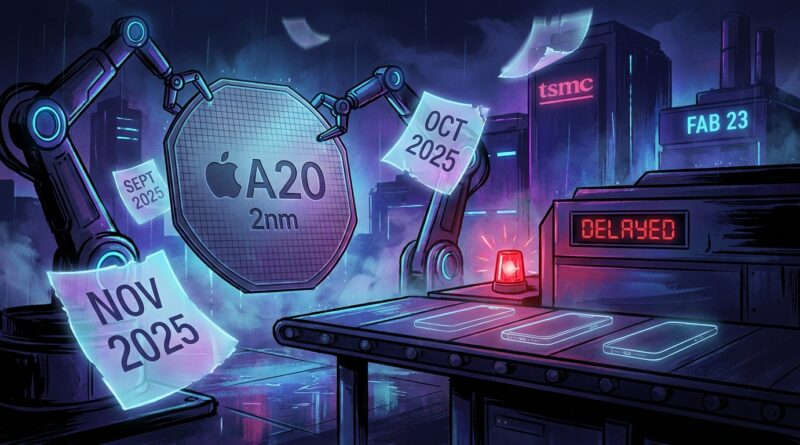
iPhone 18 Delay Leak: How Apple’s 2nm Chip Gamble Could Push Back The Next Big Release
If you were counting on the iPhone 18 showing up right on Apple’s usual September schedule, this leak is the part worth paying attention to. I get why that is annoying. Most coverage is busy arguing about colors, thinner bezels, and camera bumps, while the thing that could actually mess with your upgrade plans is far less visible. It is the chip. More specifically, Apple’s reported plan to move the iPhone 18 line onto TSMC’s early 2nm production for the A20 and A20 Pro. That sounds exciting on paper. In practice, it can create bottlenecks fast. Early chip nodes are expensive, tricky to scale, and often uneven at first. If Apple has reserved most of that first wave of 2nm capacity, some models could launch in smaller numbers, later than expected, or in stages. That is the kind of leak that matters if you are planning a trade-in, contract switch, or accessory purchase.
⚡ In a Hurry? Key Takeaways
- The iPhone 18 could still be announced in September, but some models may ship later if 2nm A20 chip supply is tight.
- If you upgrade every year, hold off on trade-ins and accessory pre-buys until model-by-model shipping dates are clearer.
- This is less about a design leak and more about supply risk. Early cutting-edge chips often cause limited stock first.
Why this leak matters more than the usual iPhone gossip
Apple can hide a lot of drama behind a polished keynote. A slick video, a few applause lines, then a preorder date. But chips do not care about stagecraft.
The search term people should really be watching is iPhone 18 release date delay 2nm A20 chip leak, because that gets to the heart of the issue. If the A20 and A20 Pro are tied to TSMC’s first meaningful 2nm ramp, Apple may be trying to do something ambitious on a very tight production timetable.
That is where delays begin. Not always a full event delay. Sometimes it is more subtle. Apple announces everything on time, then one or two models get pushed into October, or they launch with very weak availability for weeks.
What is the 2nm gamble, in plain English?
Think of TSMC like the world’s most advanced kitchen for making chips. Apple is one of its biggest customers, and usually one of the first in line for new recipes. The move from 3nm to 2nm is not just a tiny number change. It is a major manufacturing step.
Smaller process nodes can bring better efficiency and performance. That means faster phones, better battery life, and more room for AI features, camera processing, and thermal control. Apple obviously wants that story for the iPhone 18.
But first-generation production on a new node is hard. Yield is the big issue. Yield means how many good chips come out of each batch. If yields are lower than expected, Apple may not get enough A20 chips for every model in the volume it wants.
Why Apple may still push ahead anyway
Because Apple likes being first when the payoff is big enough. A strong chip lead helps justify premium pricing and keeps the iPhone looking ahead of rivals in benchmarks, battery life, and on-device AI tasks.
If Apple believes 2nm gives the iPhone 18 a real edge, it may accept some launch pain to get there.
What the A20 and A20 Pro leak suggests
The key part of this rumor is not just that Apple wants 2nm. It is the idea that Apple may have locked up a huge portion of early 2nm capacity at TSMC for the A20 and A20 Pro.
That creates two possible problems.
1. There may not be enough chips for a normal day-one rollout
Apple sells iPhones at massive scale. Even a minor shortfall becomes a real-world delay fast. If one or two models need the full-fat A20 Pro and TSMC cannot supply enough of them, Apple has three options.
- Delay those models.
- Launch them with limited stock.
- Split the lineup so some phones ship later.
We have seen versions of this before with Apple products. Not always because of the exact same cause, but the pattern is familiar.
2. Apple may need to change its plan midstream
If 2nm ramps slower than expected, Apple could downgrade part of the lineup to a less advanced process than originally planned. That is where talk of a shift away from N2P, or changes in process choice, starts to matter.
For regular buyers, that sounds technical and distant. It is not. It affects how many phones Apple can make, which models get priority, and whether the spec sheet ends up matching early expectations.
The N2 versus N2P wrinkle
This is the part that sounds like chip-nerd alphabet soup, but it actually matters.
N2 is TSMC’s 2nm-class node. N2P is an improved version expected to offer better performance and efficiency. If Apple had hoped to use a more mature or better-tuned version of 2nm, but has to settle for an earlier or less ideal process, that can affect both timing and volume.
It can also lead to awkward product decisions. For example, Apple might reserve the best chips for Pro models first. That would be a very Apple move. Great for margins. Less great if you were hoping the standard iPhone 18 would be easy to find at launch.
Why overloaded 3nm lines could make this worse
You might think Apple could just fall back to 3nm and call it a day. Simple, right? Not necessarily.
TSMC’s 3nm lines are already in heavy demand across phones, laptops, tablets, and other high-end devices. If Apple suddenly needs more 3nm capacity because 2nm is not ready in enough volume, it cannot always snap its fingers and get it.
That is the hidden pressure point here. A backup plan only works if the backup factory space is available.
So if 2nm is tight and 3nm is crowded, Apple could be stuck choosing between smaller launch quantities and staggered shipping dates.
What a delay would probably look like in real life
For most readers, the big question is simple. Does this mean the iPhone 18 is late?
Maybe. But probably not in the dramatic, all-or-nothing way people picture.
Most likely scenario
Apple still holds its normal September event window, announces the whole lineup, then quietly lets shipping times slip for one or more models.
The Pro Max or any brand-new slim, premium, or special model would be the most obvious candidate if supply is tight. High-end chips usually get hit first because demand is strong and production is more demanding.
Less likely but still possible
Apple staggers the lineup more openly. Standard models first. Pro models later. Or one specific version ships weeks after the others.
Worst-case scenario
Apple has to move the whole release rhythm back. That is still not the most likely outcome, but it is no longer impossible if the chip supply picture gets uglier.
Which iPhone 18 models might slip first?
If this leak is accurate, the first models at risk are the ones with the most demanding chip targets and the highest early demand.
- Pro models. Apple often gives these the newest silicon features first.
- Pro Max or Ultra-style versions. Big demand, premium positioning, harder to keep in stock.
- Any all-new form factor. If Apple introduces a thinner or redesigned model, that adds another manufacturing headache on top of the chip issue.
The standard iPhone 18 may actually be safer if Apple wants at least part of the lineup on shelves quickly.
What smart buyers should do now
This is the practical bit. If you are planning an upgrade, do not let rumor-season excitement push you into bad timing.
Wait before locking in a trade-in
Trade-in values can change. If the iPhone 18 ships later than usual, you do not want to hand over your current phone too early or get stuck on a temporary backup device longer than expected.
Do not pre-buy accessories yet
Cases, chargers, lens kits, docks. Leave them in your cart for now. If launch timing shifts or model dimensions change, those early accessory buys can turn into returns.
Watch carrier contract timing
If your carrier upgrade window opens in late summer, check whether it can be stretched into fall. A few weeks of flexibility could save you from upgrading into the wrong phone or missing launch promos.
If your current iPhone is struggling, make a backup plan
Battery health below 80 percent, cracked screen, flaky charging port. Those things matter more if the next phone may be delayed. A battery replacement or small repair now could buy you a few extra months and reduce stress.
How seriously should you take this leak?
With calm interest, not panic.
Supply-chain leaks are often more useful than cosmetic leaks because they point to real constraints. Apple can change colors at the last minute. It cannot magically make millions of advanced chips appear.
That said, early chip-production reports are not the same as a confirmed delay. Apple is famous for squeezing suppliers hard, shifting priorities quickly, and making a messy situation look smooth from the outside.
So the right reading is this. The risk is real. The final impact is still uncertain.
What this says about Apple’s strategy
It tells us Apple is still willing to bet big on silicon leadership. That is not surprising. The chip is now the center of the product story, even if marketing spends more time on cameras and AI tricks.
If the iPhone 18 really depends on 2nm A20 chips at scale, then Apple is treating its next phone as a major performance and efficiency step, not just another yearly refresh. That is exciting. It also raises the odds of launch friction.
And honestly, that is the part too many leak roundups miss. The prettiest render in the world does not matter if your chosen model is backordered for five weeks.
At a Glance: Comparison
| Feature/Aspect | Details | Verdict |
|---|---|---|
| Likely announcement timing | Apple may still announce the iPhone 18 in its usual September window. | Announcement on time looks more likely than a full event delay. |
| Shipping risk | Early 2nm A20 and A20 Pro supply could be tight, especially for premium models. | Expect possible staggered shipping or limited stock first. |
| Best buyer move right now | Delay trade-ins, avoid early accessory buys, and keep carrier plans flexible. | Smart planning now can save money and hassle later. |
Conclusion
The big takeaway is simple. If you want to understand the iPhone 18, stop staring only at the outside of the phone and start looking at the chip pipeline. This helps the community today because most iPhone 18 coverage is stuck on surface-level leaks while serious signs of a timing shakeup are starting to appear in the chip supply chain. By explaining how Apple’s 2nm A20 and A20 Pro allocation at TSMC, potential downgrades from N2P, and overloaded 3nm lines could collide with Apple’s usual September window, you get a much clearer picture of when the phones are actually likely to ship and which models might slip first. That kind of timing insight is useful. It helps you plan trade-ins, carrier contracts, and accessory buys before the hype cycle blindsides you. For now, the smart move is to stay interested, stay skeptical, and keep your upgrade timing flexible.