iPhone 17e vs iPhone 17: The ‘Budget’ Model Leaks Apple Didn’t Expect You To Read This Closely
Trying to compare the iPhone 17e vs iPhone 17 right now is annoying for a simple reason. Apple is very good at making the cheaper phone look almost close enough. Then the fine print starts. Suddenly you notice the older notch, the single rear camera, the different modem, and a few small cuts that do not sound like a big deal until you live with them for two or three years. That is where buyer regret starts.
The iPhone 17e seems built for people who want the newest chip without paying full iPhone 17 money. That sounds smart. Sometimes it is. But leaks and early reporting suggest Apple did not just trim luxury features. It mixed old hardware ideas with new silicon in a way that makes the 17e feel less like a mini iPhone 17 and more like a carefully controlled compromise. If you are wondering whether the 17e is a smart buy or a trap, here is the side-eye version of the story, in plain English.
⚡ In a Hurry? Key Takeaways
- The iPhone 17e looks like the value pick, but the regular iPhone 17 is likely the better long-term buy if camera flexibility, display polish, and fewer compromises matter to you.
- Buy the 17e if you mostly want strong performance, iPhone longevity, and a lower price. Spend more on the 17 if you keep phones for 3 to 5 years and care about photos, convenience, and resale.
- The real risk is assuming the 17e is just a cheaper 17. It is not. It is a different mix of parts, and that difference can affect daily use more than the spec sheet suggests.
Why the iPhone 17e is the most confusing model in the lineup
Most of the attention is going to the flashy models. That is normal. But the iPhone 17e is where Apple’s lineup strategy gets really interesting.
On paper, it sounds simple. You get a newer chip, a lower starting price, and the comfort of buying a current-generation iPhone. For a lot of shoppers, that is enough to stop reading. It should not be.
The rumored and leaked story around the iPhone 17e vs iPhone 17 points to something more complicated. The 17e appears to borrow some older design choices, especially the notch, while keeping enough new internals to feel modern. Apple loves this kind of product. It gives just enough to look fresh, while holding back enough to protect the more expensive model.
Design and display. This is where the split becomes obvious
The notch is not just cosmetic
If the leaks are right, the iPhone 17e keeps the notch while the regular iPhone 17 sticks with the newer front design language. For some people, that will not matter at all. For others, it will make the 17e feel old on day one.
This is not only about looks. The front design changes how modern the phone feels every time you unlock it, watch video, or use full-screen apps. You do not notice it in a spec chart. You notice it when the phone is in your hand 200 times a day.
The regular 17 is likely the nicer phone to live with
Even if both screens are good, Apple usually saves the smoother and more premium feel for the standard model and above. That can mean brightness, panel quality, bezel polish, and general visual refinement.
So if you are choosing between the iPhone 17e vs iPhone 17 based on daily comfort, the regular 17 is already starting to pull ahead.
Performance. The 17e may be faster than it looks
Here is the part that makes the 17e tempting. It is expected to get very current silicon, which means strong speed, good app support, and a long software life.
For basic users, that matters more than many premium features. If your phone life is texting, maps, email, banking, social apps, streaming, and casual photos, the 17e could feel plenty fast for years.
That is the trap and the appeal. Apple may give the 17e enough raw power to make it seem like the obvious smart buy. And for some people, it will be.
But chips do not tell the whole story. A phone can have a great processor and still feel more limited because of its camera setup, modem, display, or design shortcuts.
The modem question matters more than most people think
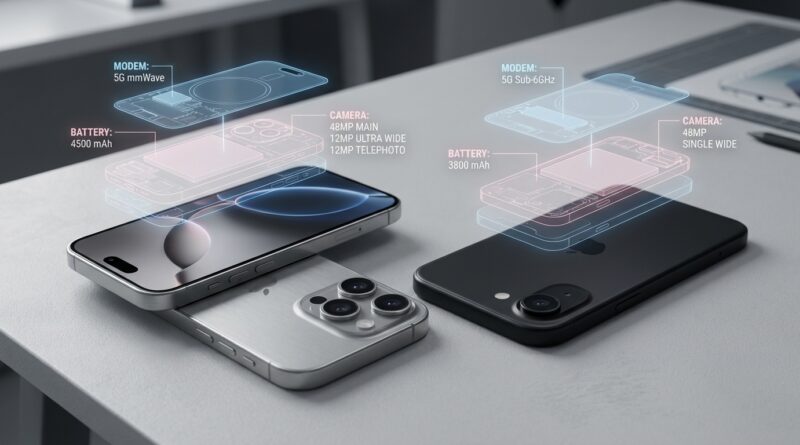
One of the quieter differences in the iPhone 17e vs iPhone 17 discussion is the modem. If the 17e uses a different modem than the regular 17, that is not a nerd-only issue.
Your modem affects signal behavior, efficiency, and how gracefully your phone handles crowded networks or weak coverage. In real life, that means call stability, upload speed, and battery use when you are in a bad signal area.
If you spend most of your time on solid Wi-Fi in a city, you may never care. If you commute, travel, live in a fringe coverage area, or use your phone heavily off Wi-Fi, a lesser modem can quietly become one of the biggest differences between two phones that seem similar in ads.
Camera. This is probably the biggest everyday sacrifice
A single 48 MP camera is not the same as a flexible camera system
The 17e is expected to use a single-lens 48 MP rear camera. That sounds great because 48 MP sounds premium. But megapixels by themselves do not tell you how a camera behaves.
A single-lens setup can still produce very nice photos, especially in good light. It can also crop in for a pseudo-zoom effect that looks fine for casual use. But it cannot fully replace the flexibility of a multi-camera system on the regular iPhone 17.
That matters when you are taking kid photos indoors, food shots in dim restaurants, pet photos that do not sit still, or travel pictures where framing options make the difference between “nice” and “wow.”
The regular iPhone 17 should be the safer choice for people who actually use their camera a lot
If your camera roll is full and your phone is your only camera, the regular 17 is likely worth the extra money. Not because the 17e will be bad, but because it will be more limited in ways that show up over time.
This is classic Apple segmentation. The cheaper phone gets one impressive-sounding camera and enough image processing to keep marketing happy. The more expensive phone gets the flexibility people miss only after they buy the cheaper one.
Battery life could go either way, but efficiency will matter
The interesting thing about a simpler phone is that it can sometimes surprise you on battery life. Fewer camera components, a different screen setup, and an efficient chip can all help the 17e last longer than people expect.
But modem behavior matters here too. If the 17e’s modem is less efficient in weak coverage, battery life can drop fast in the real world. So when comparing the iPhone 17e vs iPhone 17, do not trust launch-day battery claims too quickly. Wait for real testing from people using the phones on actual networks.
Who should buy the iPhone 17e
The 17e makes sense if you fit one of these groups:
- You want the newest possible iPhone for the lowest entry price.
- You care more about speed and software support than camera extras.
- You mostly use your phone for everyday tasks and keep things simple.
- You are upgrading from an older iPhone with a notch already, so the design will not bother you.
For these buyers, the 17e could be the practical choice. Not exciting. Practical. And sometimes that is exactly the right move.
Who should skip it and get the iPhone 17 instead
You should seriously consider spending more on the regular iPhone 17 if any of this sounds like you:
- You keep your phones for a long time and want fewer compromises haunting you later.
- You use your camera a lot and care about flexibility, not just headline megapixels.
- You want the newer design and do not want a current phone that already looks one generation behind.
- You travel, commute, or depend on strong mobile connectivity away from Wi-Fi.
This is the group that usually regrets buying the cheaper phone. Not because it is bad, but because the little missing things start to stack up.
The real question. Is the 17e a bargain or a bait phone?
It is probably neither. It is more calculated than that.
The iPhone 17e looks like Apple’s way of offering a current iPhone at a friendlier price without actually undercutting the regular iPhone 17. That is a very Apple move. You get enough newness to feel current, enough power to feel safe, and enough missing pieces to make the upsell still look reasonable.
So the answer in the iPhone 17e vs iPhone 17 debate is not “which one is better” in a vacuum. The regular 17 is almost certainly better. The smarter question is whether the cuts on the 17e hit the things you personally use every day.
If they do, skip it. If they do not, save the money and feel good about it.
At a Glance: Comparison
| Feature/Aspect | Details | Verdict |
|---|---|---|
| Design and display | 17e is expected to keep older visual cues like the notch, while the 17 should feel more current and premium. | iPhone 17 wins for everyday feel. |
| Performance and longevity | 17e should still get modern silicon, making it fast enough for most people and likely strong on long-term software support. | 17e offers strong value here. |
| Camera and flexibility | 17e may rely on a single 48 MP rear camera, while the 17 should offer a more versatile imaging setup. | iPhone 17 is the safer buy for photo-heavy users. |
Conclusion
The iPhone 17e is the freshest and most confusing part of Apple’s lineup because it is not really a cheap iPhone 17. It is a carefully mixed phone with older design cues like the notch, new silicon, a different modem, and a single-lens 48 MP camera that may sound close to the main 17 but will not behave the same way in daily use. That is why this comparison matters right now. If you want the lowest-cost route into a new iPhone and your needs are simple, the 17e could be a very sensible buy. If you want fewer compromises over the next few years, the regular iPhone 17 is likely the better long-term pick. The good news is that once you see Apple’s segmentation clearly, the choice gets easier. You stop shopping by hype, and start buying for the way you actually use your phone.